
Metro Vancouver Housing Market – September 2026
Apartment Sales Decline as Buyers Gain Leverage
The Metro Vancouver housing market in September 2026 continued to experience softer demand, with apartment sales leading the decline. While detached homes and townhouses recorded modest year-over-year sales increases, overall activity remained well below historical averages. Inventory remains elevated, benchmark prices continue to gradually decline, and buyers are gaining negotiating leverage across several market segments. As the fall market begins, buyers and sellers are navigating an increasingly price-sensitive environment where strategy matters more than ever.
Metro Vancouver Real Estate Stats – September 2026
Overall market activity remained subdued, with sales declining year-over-year and inventory staying above historical norms:
- Total Sales: 1,717 (↓8.4% YoY)
- 10-Year Average Sales: 2,289 (↓25.0%)
- New Listings: 5,852 (↓10.3% YoY)
- Total Active Listings: 16,394 (↓4.0% YoY, ↑24.3% above 10-year average)
- Benchmark Price (All Property Types): $1,075,900
- ↓5.5% YoY
- ↓0.6% MoM
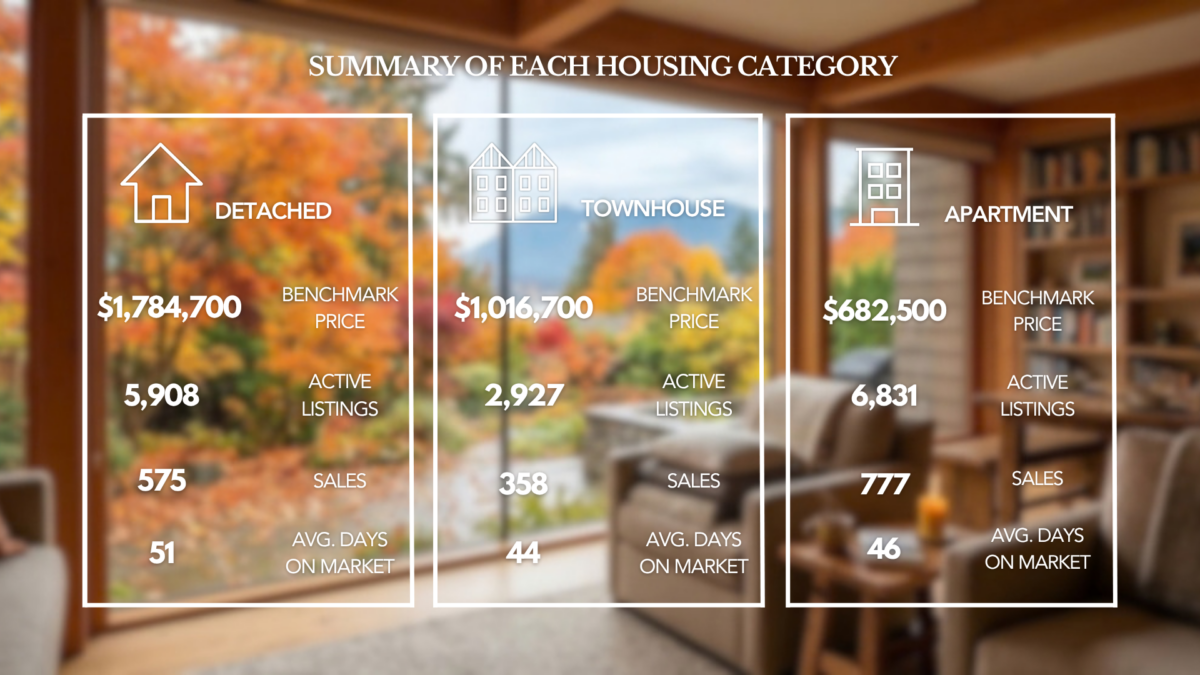
Detached Homes vs. Condos Vancouver: Segment Breakdown
Detached Homes
- Active Listings: 5,908
- Sales: 575 (↑4.2% YoY)
- Benchmark Price: $1,784,700
- ↓7.3% YoY
- ↓0.8% MoM
- Average Days on Market: 51
Takeaway: Detached home sales showed modest improvement compared to last September, but prices continued to soften. With homes taking an average of 51 days to sell, buyers still have considerable negotiating leverage.
Townhouses
- Active Listings: 2,927
- Sales: 358 (↑0.6% YoY)
- Benchmark Price: $1,016,700
- ↓4.7% YoY
- ↓1.2% MoM
- Average Days on Market: 44
Takeaway: Townhouse sales remained relatively stable year-over-year, although benchmark prices experienced the largest monthly percentage decline among the three property types.
Apartments (Condos)
- Active Listings: 6,831
- Sales: 777 (↓18.6% YoY)
- Benchmark Price: $682,500
- ↓6.2% YoY
- ↓0.5% MoM
- Average Days on Market: 46
Takeaway: The apartment market continues to face the greatest demand challenges, with sales declining nearly 19% year-over-year. Softer prices and elevated inventory are creating more opportunities for condo buyers.
Market Analysis: Apartment Sales Drive the Downturn
The September 2026 Vancouver real estate stats reveal an important distinction between housing segments.
Although overall residential sales declined 8.4% year-over-year, the weakness was concentrated primarily in the apartment market.
According to Andrew Lis, Chief Economist and Vice-President of Data Analytics at Greater Vancouver REALTORS®:
“While sales were down about eight per cent overall in September, this figure hides the fact the weakness is contained to the sizeable apartment segment…”
This divergence suggests that the market is increasingly being driven by buyers purchasing homes for personal use rather than investors.
Key trends include:
- Detached homes: Sales increased 4.2% year-over-year.
- Townhouses: Sales increased slightly by 0.6%.
- Apartments: Sales declined significantly by 18.6%.
- Overall market: Sales remained 25% below the 10-year seasonal average.
Lis also highlighted that end-users are primarily driving market activity while investor demand remains subdued.
This helps explain why detached and townhouse sales are showing greater resilience while apartments continue to struggle.
For the broader Metro Vancouver housing market, the message is clear: demand hasn’t disappeared entirely, but buyers are becoming increasingly selective about where and what they purchase.
Inventory Remains Elevated as Prices Continue to Soften
Another important trend in September was the continued slowdown in new listings.
There were 5,852 new listings, down 10.3% compared with September 2025.
Meanwhile, total active listings reached 16,394, representing:
- A 4% decrease year-over-year.
- Inventory levels 24.3% above the 10-year seasonal average.
- Continued ample selection for prospective buyers.
Although fewer properties are entering the market, demand remains too weak to generate significant upward price pressure.
The composite benchmark price declined to $1,075,900, down 5.5% year-over-year.
Lis explained that the combination of slow sales and declining inventory has prevented prices from falling more rapidly.
He also noted that the cumulative effect of modest monthly declines has become increasingly noticeable, with benchmark prices across all major property types approximately 3% lower than at the beginning of 2026.
This is an important reminder that small monthly price changes can add up over time.
For buyers, gradual price adjustments can create opportunities.
For sellers, these changes reinforce the importance of pricing according to current market conditions rather than relying on previous years’ valuations.
Sales-to-Active Listings Ratio: Why It Matters
The Sales-to-Active Listings Ratio (SALR) is one of the most important indicators for understanding whether market conditions favour buyers or sellers.
Overall Market: 10.9%
Detached: 9.7%
Townhomes: 12.2%
Apartments: 11.4%
How to Interpret This:
Below 12% → Buyer’s Market
Downward pressure on prices can occur when the ratio remains below this level for a sustained period.
12%–20% → Balanced Market
Neither buyers nor sellers hold a significant overall advantage.
Above 20% → Seller’s Market
Sustained ratios above this level can contribute to upward pressure on prices.
What This Means Right Now:
- Detached homes (9.7%) remain firmly in buyer’s market territory.
- Townhomes (12.2%) are just inside balanced market territory.
- Apartments (11.4%) have moved into buyer’s market territory.
- The overall market (10.9%) is now below the threshold traditionally associated with downward price pressure.
This represents a notable shift from August, when the overall ratio was 12.3%.
The September numbers suggest that market conditions have become more favourable for buyers, particularly in the detached and apartment segments.
However, the impact on individual properties will still depend on neighbourhood, condition, pricing, and competition.
What This Means for Buyers and Sellers
For Buyers
September’s market conditions provide opportunities for buyers who are financially prepared and willing to negotiate.
- Elevated inventory → More choice: Buyers can compare more properties before making decisions.
- Softening benchmark prices → Potential opportunities: Gradual price declines may improve purchasing options.
- Lower sales activity → Less competition: Buyers may face fewer competing offers.
- Buyer’s market conditions → Greater negotiating leverage: Particularly in the detached and apartment segments.
With detached and apartment sales-to-active listings ratios below 12%, buyers may have greater flexibility when negotiating price, conditions, and completion dates.
However, buyers should still evaluate individual properties carefully. A lower benchmark price does not automatically mean every listing represents good value.
For Sellers
The September market continues to reward realistic pricing, preparation, and strong marketing.
- Strategic pricing is essential: Buyers are increasingly price-sensitive.
- Presentation matters: Professional photography, staging, and targeted marketing help properties stand out.
- Competition remains elevated: Sellers must account for available alternatives in their neighbourhood.
- Longer selling periods require planning: Detached homes averaged 51 days on market, while apartments averaged 46 days.
For detached and condo sellers, understanding the current level of buyer demand is especially important.
Townhouses continue to show relatively more balanced conditions, but even this segment is experiencing downward price adjustments.
The key is to position a property competitively from the beginning rather than relying on an overly optimistic asking price.
Final Thoughts
The Metro Vancouver Housing Market in September 2026 continues to shift toward conditions that increasingly favour buyers.
We are seeing:
- Overall sales decline 8.4% year-over-year.
- Apartment sales fall 18.6%, leading the market slowdown.
- Detached and townhouse sales post modest annual gains.
- Inventory remain 24.3% above historical averages.
- Benchmark prices continue gradually declining.
- The overall sales-to-active listings ratio fall to 10.9%.
- Detached homes and apartments sit in buyer’s market territory.
The biggest takeaway is that Metro Vancouver is no longer simply a balanced market experiencing slower activity. Buyer-favourable conditions are becoming more apparent across multiple property types.
For buyers, this creates opportunities to negotiate and make informed decisions without the urgency seen in stronger markets.
For sellers, success increasingly depends on understanding current demand, setting realistic expectations, and executing a thoughtful marketing strategy.
As we move further into the fall market, the question is whether reduced inventory will eventually help stabilize prices or whether continued weak demand will keep downward pressure on the market.
For now, this remains a strategy-driven market where local knowledge and careful planning make all the difference.
Browse current opportunities across Metro Vancouver:
👉 Search for Properties
Read Next:
👉 This is What the Next Chapter Looks Like: 2305 W King Edward, Vancouver
👉 The Kitchen That Was Built to Be Used: Inside 2305 W King Edward, Arbutus
👉 When Paying a Mortgage Penalty Actually Makes Sense
👉 Why I Bought During the 2025 Volatility and What That Has To Do With Last Week’s Rate Drop
👉 Why Two Years Left on Your Mortgage Does Not Automatically Mean You Should Wait
Ehsan Sharenejad PREC*
Powered by Propel Real Estate Marketing Inc.
778-910-2876